Why Designers and Educators Are Choosing the Colorful Calculator Vector Illustration for Versatile Visual Projects
Vector graphics have long been the backbone of scalable, professional design—especially in contexts where clarity, adaptability, and visual appeal matter. Among the growing library of thematic vector assets, the Colorful Calculator Vector Illustration stands out not just for its vibrant aesthetics but for its thoughtful functionality. Unlike generic clipart or raster-based icons, this set bridges practical utility with creative flexibility—making it a strategic choice across diverse fields: from classroom materials and edtech interfaces to marketing collateral and product packaging.
What Makes This Bundle More Than Just “Cute Icons”
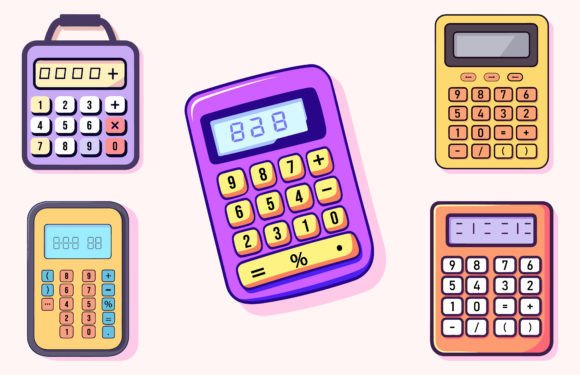
The Back to School Calculator Vector Bundle delivers five distinct calculator designs, each rendered in high-fidelity vector format. What sets it apart is not merely the cheerful palette—think teal gradients, coral buttons, sunflower-yellow displays—but how each element is constructed: every button, screen, casing, and shadow is built as a separate, labeled vector shape. That means no flattening, no embedded rasters, and no guesswork when adjusting proportions or recoloring components.
This level of modularity supports real-world workflows. A curriculum designer building an interactive math worksheet can isolate the “equals” button to animate it on click. A UI developer prototyping a financial literacy app can extract the display area, replace its placeholder text with dynamic variables, and scale it seamlessly across device breakpoints. Even a small-business owner designing promotional flyers for a tutoring service can rebrand the entire calculator by swapping two hex values—no redesign needed.
Educators Building Engaging Learning Tools
In today’s hybrid learning environment, static PDFs and monochrome handouts often fail to hold attention—especially among younger learners. The Colorful Calculator Vector Illustration offers educators a ready-made, classroom-ready asset that aligns with evidence-based design principles: color coding supports memory retention, consistent iconography builds visual literacy, and clean vector outlines ensure legibility even when projected at 120 inches. One elementary math specialist reported using the bundle to create printable “calculator scavenger hunts,” where students match vector button shapes to corresponding operations—turning abstract symbols into tactile, visual anchors.
Designers Crafting Cohesive Brand Experiences
For freelance designers and in-house creative teams, consistency is currency. When illustrating a fintech SaaS dashboard, a single calculator icon may appear in tooltips, empty states, and feature cards. Using five unique variants from the same stylistic family—each sharing proportional logic, stroke weights, and corner radii—ensures visual harmony without sacrificing variety. Because all files are delivered in both EPS and PNG formats, designers can embed vectors directly into Adobe XD or Figma (via SVG conversion), while also exporting crisp raster previews for client presentations or CMS uploads.
Developers Integrating Scalable Assets Into Digital Products
Front-end developers increasingly rely on SVGs for performance-critical interfaces. With the Colorful Calculator Vector Illustration set, engineers can import EPS files into tools like Illustrator or Inkscape, export optimized SVGs with meaningful IDs (e.g., screen-display, button-plus), and manipulate them via CSS or JavaScript. One edtech startup used these vectors to build a responsive “practice mode” interface: pressing a virtual button triggered both a sound cue and a subtle transform animation—all possible because each shape was editable and accessible in the DOM.
Small Business Owners Enhancing Print & Digital Collateral
A local tutoring center launching a summer STEM camp didn’t commission custom illustrations—they leveraged the bundle to produce branded worksheets, email headers, social media banners, and even vinyl decals for their learning lab walls. Because the ZIP file contains both EPS (for professional print shops) and PNGs (with transparent backgrounds for web use), they avoided costly format conversions or licensing ambiguities. Crucially, the absence of fonts or external dependencies meant zero risk of missing typefaces during printing—a common pitfall with less rigorously prepared assets.
Technical Strengths That Support Long-Term Usability
Beyond aesthetics, the technical execution of the Colorful Calculator Vector Illustration reflects deep understanding of production realities:
- 100+ individual vector shapes—not grouped layers or flattened artboards—allow granular control over shadows, highlights, bezels, and screen reflections;
- Cross-software compatibility: EPS files open reliably in Illustrator, CorelDRAW, Affinity Designer, and even newer vector-capable versions of Inkscape;
- Resolution independence: Whether scaling to billboard size or shrinking to a 24px toolbar icon, edges remain razor-sharp—no anti-aliasing artifacts or pixelation;
- No embedded fonts or effects: All text elements are outlined; all gradients are native vector fills—ensuring predictable rendering across platforms;
- ZIP compression with intuitive naming: Files follow a logical convention (
calculator-blue.eps,calculator-green.png), eliminating confusion during asset handoff or version control.
This isn’t theoretical robustness—it’s field-tested reliability. A university communications team used the bundle across 17 departments’ websites, internal newsletters, and accessibility-compliant PDFs. Their only modification? Replacing the default pastel background with WCAG-AA-compliant contrast ratios—completed in under 90 seconds per file.
How It Fits Into Broader Design & Educational Trends
The rise of the Colorful Calculator Vector Illustration mirrors larger shifts in digital content creation. First, there’s the move toward “design systems thinking”—where reusable, well-documented components replace one-off graphics. Second, there’s growing emphasis on inclusive visual language: research shows that color-coded numeracy tools improve engagement among neurodiverse learners, particularly those with ADHD or dyscalculia. Third, educators and creators alike are prioritizing “time-to-value”: rather than spending hours sourcing, editing, and troubleshooting low-quality assets, professionals invest in vetted, production-ready resources that integrate smoothly into existing pipelines.
Notably, this bundle avoids trend-chasing gimmicks—no exaggerated skeuomorphism, no forced 3D depth, no overly stylized distortions that sacrifice recognizability. Each calculator maintains clear affordances: rounded buttons signal touch targets, subtle drop shadows imply layering, and the display window uses high-contrast fill to mimic actual LCD readability. That balance between personality and purpose is why it endures beyond seasonal “back to school” campaigns—and appears just as naturally in tax-prep guides, budgeting workshops, and coding bootcamp slides.
Practical Considerations Before Implementation
While the Colorful Calculator Vector Illustration excels in versatility, thoughtful integration matters. Here’s what users consistently highlight as key considerations:
- Intended output medium: For large-format print (banners, posters), stick with EPS or high-DPI PNG exports. For web use, convert to SVG and inline critical elements to reduce HTTP requests;
- Color accessibility: The default palette meets standard contrast ratios, but always verify against your brand’s base colors—especially if overlaying text on the display area;
- Editing familiarity: Users comfortable with vector paths will maximize value; beginners may benefit from watching a 5-minute tutorial on ungrouping and recoloring in their preferred tool;
- Licensing scope: The bundle permits commercial use—including resale in templates and SaaS dashboards—as long as the vectors aren’t redistributed as standalone assets. Always review the included license document before enterprise deployment;
- Workflow alignment: If your team relies heavily on Figma libraries or Sketch symbols, plan for initial setup time to convert and organize the five variants into a shared, version-controlled component system.
One instructional designer noted that after importing the bundle into her team’s Figma workspace, she created a “Calculator Component Kit” with auto-layout frames, variant properties for button states (hover, active, disabled), and linked documentation—transforming five static files into a living, collaborative design resource.
Conclusion: Utility Woven Into Every Curve and Gradient
The enduring value of the Colorful Calculator Vector Illustration lies not in novelty, but in quiet competence. It doesn’t shout for attention—it solves problems. It doesn’t impose a singular style—it adapts. Whether anchoring a kindergarten counting lesson, reinforcing decimal concepts in a community college workshop, or adding visual warmth to a corporate financial dashboard, it operates with consistent precision and expressive clarity. In an ecosystem saturated with disposable graphics, this bundle earns its place through craftsmanship, intentionality, and respect for the people who use it—not as passive consumers, but as active makers shaping how knowledge, numbers, and ideas are communicated across generations and platforms.