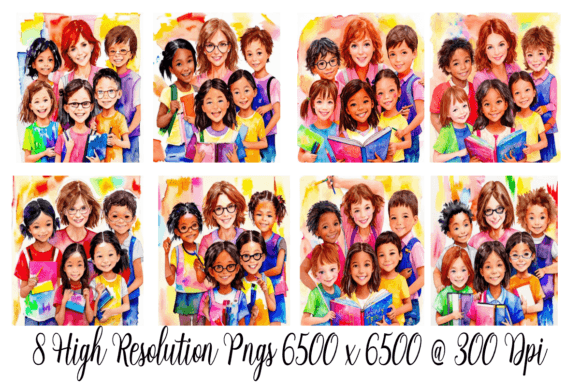
Teachers and Students Watercolor 8
Teachers and Students Watercolor 8 is more than a decorative asset—it’s a strategic visual tool designed for professionals who understand that intentionality in communication starts with thoughtful imagery. This collection consists of eight handcrafted watercolor portraits, each rendered at 6500 × 6500 pixels and 300 DPI, delivering exceptional clarity whether printed on large-format banners or scaled down for digital newsletters. The scenes depict authentic classroom moments: a teacher guiding a small group, students collaborating at a table, quiet focus during independent work, shared laughter over a science experiment. These aren’t generic silhouettes or stock clichés—they’re emotionally grounded, compositionally balanced, and rich in subtle detail: the texture of paper, the soft wash of light across a chalkboard, the warmth in a student’s expression as they raise their hand.
Why Visual Strategy Matters in Back-to-School Planning
For educators, school administrators, curriculum designers, and education-focused marketers, the first two weeks of the academic year set the tone—not just for students, but for stakeholder perception. Brochures, welcome packets, orientation slides, website banners, and social media announcements all serve as touchpoints where credibility, warmth, and competence are silently assessed. Using Teachers and Students Watercolor 8 thoughtfully signals attention to nuance and human-centered values—qualities that resonate deeply with parents, donors, and district leadership. Unlike overly polished vector graphics or AI-generated images that risk feeling detached, these portraits carry the quiet authenticity of hand-drawn art, reinforcing trust through perceived care and craft.
Where and How to Apply Teachers and Students Watercolor 8 Intentionally
Strategic application begins with alignment—not aesthetics alone. Before inserting a file into your layout, ask: What outcome am I supporting? Here are grounded use cases:
- Brand consistency across print and digital: Use one portrait consistently as the hero image across your school’s back-to-school campaign—on the homepage banner, printed welcome letter, and email header. Repetition builds recognition without repetition fatigue, especially when the image carries emotional continuity.
- Curriculum resource kits: Embed individual portraits into editable PDF lesson plans or professional development handouts. A watercolor vignette beside a pedagogical tip subtly reinforces the “why” behind the strategy—making abstract concepts feel anchored in real practice.
- Grant proposals and funding materials: Replace generic classroom stock photos with Teachers and Students Watercolor 8 in appendices or cover pages. Reviewers process visuals faster than text—and a distinctive, high-resolution watercolor suggests both creativity and rigor in program design.
- Internal communications for staff onboarding: Include a portrait in the first-week orientation deck not as decoration, but as a visual anchor for core values—e.g., pairing a scene of collaborative learning with your school’s equity statement.
Avoid using all eight files interchangeably across unrelated contexts. That dilutes thematic focus and weakens messaging cohesion. Instead, select two or three that best reflect your current priority—say, student agency or inclusive instruction—and build around them.
Planning Considerations Before You Download
High resolution doesn’t equal automatic impact. Consider these practical factors before integrating Teachers and Students Watercolor 8 into your workflow:
- File management discipline: With eight large PNGs (each ~25–40 MB), organize them with clear naming conventions—e.g., TSW8_student-group-collab.png—and store them in a dedicated, backed-up folder. Avoid embedding unrenamed files directly into design software; version control matters when iterating across teams.
- Color profile awareness: These files are RGB-optimized for screen use. If you plan heavy print deployment (e.g., posters, banners), confirm with your printer whether color adjustments or CMYK conversion will be needed—and test a physical proof first. Watercolor tones can shift subtly in translation.
- Licensing clarity: Teachers and Students Watercolor 8 is licensed for commercial and personal use, including resale in derivative products like printable planners or branded workshop kits—provided the original files remain unmodified as standalone assets. You may not resell or redistribute the raw PNGs themselves.
Risks of Unintentional Use
Without grounding in purpose, even strong visuals can misfire. Common pitfalls include:
- Tone mismatch: Placing a gentle watercolor portrait beside urgent policy language (“Mandatory Vaccination Compliance Deadline”) creates cognitive dissonance. The image should support, not contradict, the message’s weight and intent.
- Overuse in low-context spaces: Dropping a portrait into a slide without captioning, framing, or narrative connection risks reducing it to wallpaper—visually pleasant but functionally inert. Every image should earn its place by clarifying, humanizing, or elevating the surrounding content.
- Ignooring audience expectations: A progressive charter school may embrace expressive watercolor as part of its identity; a traditional private academy might prefer restrained line art or documentary photography. Match visual language to institutional voice—not just trend preference.
Long-Term Value Beyond Back-to-School
Teachers and Students Watercolor 8 isn’t seasonal inventory—it’s an adaptable asset with multi-year utility. Consider how it evolves with your goals:
As your team grows, repurpose portraits in internal recognition materials: a cropped detail of a teacher’s hands guiding a student’s writing becomes a quiet tribute in a staff appreciation newsletter. As curriculum shifts toward project-based learning, swap in the portrait showing students gathered around a model—reinforcing pedagogical continuity visually. When launching a new family engagement initiative, use the portrait of a parent and teacher reviewing work together—not as literal representation, but as symbolic shorthand for partnership.
This longevity depends on disciplined curation—not hoarding, but curating. Revisit your selection every six months. Does it still reflect your current priorities? Has usage revealed unexpected resonance in one portrait over others? Let real-world feedback—not assumptions—guide refinement.
Making Better Decisions About Visual Assets
Choosing Teachers and Students Watercolor 8 isn’t about acquiring “more design elements.” It’s about selecting a tool that aligns with how you want people to feel, think, and act after encountering your materials. That requires pausing before download to clarify:
- What specific decision does this image help support? (e.g., “Help parents quickly grasp our inclusive teaching approach”)
- What action do I want the viewer to take next? (e.g., “Register for orientation,” “Read the full philosophy statement,” “Share the brochure with another family”)
- How will I measure whether this choice improved clarity or connection? (e.g., higher click-through on email banners, fewer follow-up questions about classroom culture)
When used with that level of intention, Teachers and Students Watercolor 8 moves beyond decoration into the realm of functional communication—supporting better planning, clearer positioning, and more resonant storytelling. It rewards patience, precision, and reflection—not speed or volume.
Thank you for stopping by. If Teachers and Students Watercolor 8 supports the kind of thoughtful, human-centered work you value, consider adding this listing to your favorites—so you don’t miss future releases built with the same attention to detail, purpose, and practical impact.