Cute Little School Girl with Backpack
Imagine you’re designing a welcome banner for your third-grade classroom—and you want it to feel warm, inclusive, and full of quiet joy. Or maybe you’re a small business owner launching a line of back-to-school stickers for notebooks and lunchboxes. Or perhaps you’re a homeschool parent putting together printable reading logs and behavior charts that actually make your kids smile. In all these real moments, Cute Little School Girl with Backpack isn’t just another clipart pack—it’s the thoughtful visual shortcut that helps your message land with authenticity and heart.
What It Is (and Why It Feels Different)
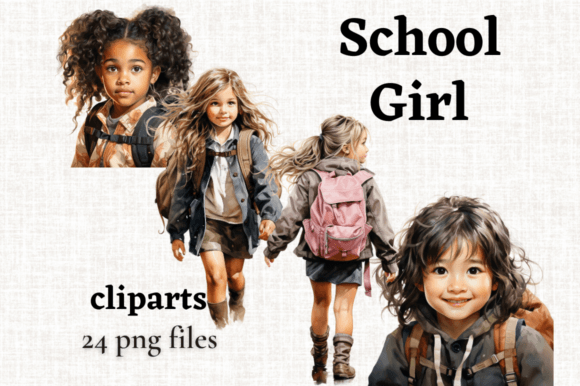
This isn’t a generic collection of cartoon schoolgirls. The Cute Little School Girl with Backpack bundle features 24 hand-crafted watercolor-style illustrations—each one showing a distinct girl, smiling, confident, and ready for learning. They’re drawn from diverse backgrounds: European, African American, Asian, and Latino—represented not as tokens, but as individuals with unique expressions, hair textures, skin tones, and subtle cultural cues (like braided styles, headwraps, or traditional patterns in clothing). Every image is saved as a high-resolution PNG with a transparent background, so there’s no awkward white box ruining your layout when you drop it into Canva, PowerPoint, or Illustrator.
Where It Fits Naturally—Not Just “On Paper”
You don’t need to be a graphic designer to get value from this set. You just need a project where warmth, representation, and clarity matter.
- Educators use these cliparts to build classroom visuals that reflect who’s actually sitting in their chairs—whether it’s a “Classroom Jobs” chart with girls holding brooms, books, or tech tablets—or a “Feelings Check-In” poster where students point to a face that matches how they’re doing today. One teacher told us she printed six versions of the same reading goal tracker, each featuring a different girl, and rotated them weekly so every student saw themselves in the material—not once, but regularly.
- Small business owners selling printable planners on Etsy lean on these images to add personality without overdesigning. A mom-run stationery shop uses the backpack-wearing girls as corner accents on weekly habit trackers—soft watercolor edges keep things gentle, while the diversity signals that her tools are made *for* real families, not a narrow ideal.
- Bloggers and content creators embed these into back-to-school roundups (“10 Low-Prep Ways to Ease First-Week Jitters”) or Instagram carousels about inclusive classroom supplies. Because the images load fast, scale cleanly, and don’t distract from text, they boost engagement without slowing things down.
- Hobbyists and crafters print them onto iron-on transfers for custom tote bags, layer them behind handwritten quotes on handmade greeting cards, or cut them out for scrapbook pages documenting a child’s first day. The transparent background means no fussy cropping—just drag, resize, and go.
How the Details Actually Help You Save Time (and Avoid Frustration)
Watercolor texture isn’t just pretty—it adds softness that digital line art often lacks. That makes these cliparts especially effective for projects meant to feel nurturing: parent handouts, social-emotional learning materials, or wellness posters for school counselors. And because each file is individually named (e.g., “girl-asian-backpack-blue-dress.png”), you’re not scrolling through 50 indistinguishable thumbnails trying to find the right one.
The transparency? That’s where practicality kicks in. If you’re making sublimation mugs for a PTA fundraiser, you won’t waste ink on white space. If you’re layering a girl over a chalkboard-textured background in Photoshop, her outline blends naturally—not like a sticker slapped on top. Even non-designers notice the difference: one freelance writer said she dropped a clipart into Google Docs for a client newsletter and was surprised how “finished” it looked—no extra editing, no second-guessing.
Things to Keep in Mind Before You Use It
This bundle shines when used intentionally—not as filler, but as intentional visual language. Ask yourself: Does this image support what I’m trying to communicate? For example, using a joyful, backpack-clutching girl next to a heading like “Welcome Back!” reinforces tone. Using the same image beside dense bullet points about curriculum standards? It may dilute focus.
Also consider context. While the collection celebrates diversity meaningfully, it’s still a curated set—not a substitute for lived experience. If you’re developing anti-bias curriculum, pair these visuals with authentic stories, voices, and resources—not just imagery. And if you plan to sell physical products (like T-shirts or stickers), double-check the license: this bundle allows commercial use, but doesn’t include extended rights for large-scale merchandising or resale as standalone clipart.
Realistic Scenarios Where It Makes a Tangible Difference
A speech therapist created laminated “emotion cards” for her K–2 clients—each card shows a different girl expressing calm, excited, frustrated, or tired. Parents reported their kids naming feelings more readily because the faces felt familiar and kind—not clinical or cartoonish.
A church volunteer designed a “Back-to-School Blessing” flyer for families in her neighborhood. She placed three girls—one Latina, one Black, one East Asian—holding open books under a watercolor sun. The pastor shared it on social media, and within hours, parents were tagging friends saying, “This is *us*.”
A freelance educator building an online course for new teachers included these cliparts in downloadable slide decks—adding visual breaks between theory-heavy sections. Students said the slides “felt human,” not like a textbook.
Why It Works Beyond Aesthetics
In a world saturated with AI-generated, overly polished, or culturally vague stock art, Cute Little School Girl with Backpack stands out by prioritizing emotional accuracy over perfection. These aren’t girls posing for a catalog—they’re girls mid-laugh, adjusting a strap, looking up with curiosity. That nuance builds trust. When your audience sees themselves—or the children they teach, serve, or love—reflected with care, they stay longer, engage deeper, and remember your message more clearly.
It’s not about adding “cute.” It’s about adding connection—quietly, consistently, and without fuss.